Showing posts with label Vintage. Show all posts

Wednesday, November 20, 2013

Vintage finds

Sadly, one of our local vintage thrifty shops closed it's doors last month. It has long been a favourite haunt; just the place to pick up old lace doilies, odd buttons, embroidered pillow shams and old ladies gloves. They have also stocked an excellent range of vintage hats, shoes, frocks, and ties, and usually enough daggy pre-loved gear to outfit one for those dress-up-parties-of-the-unmentionable-birthday variety.


Apart from the beautiful blue French embroidery cotton, I was able to pick up a silk kerchief, a couple of fine lace doilies, a string of pearls, some vintage buttons ...

... lots of assorted triangle cards of old press-studs, and a box of fine crochet cotton.

I also scored a whole bolt of scrummy chocolate-coloured braid. I can see it now, stitched around the collar and cuffs of a future Regency Spencer jacket creation ...


I spent an entire hour sitting awkwardly on the carpeted floor rifling through knitting patterns that stretched back some seventy or eighty years at least. I could have bought so many, but it was the quaint Paton's knitting booklets from the 1940s that came home with me in the end. There were baskets full of odd balls of wool, tins of knitting needles and crochet hooks; boxes of old dress patterns, magazines, and other strange assortments of ye-olde-things.

I can't help but be captivated by the ephemera of the past. Perhaps they are the things that link my modern-day life to the whisper of my grandparents' hand-me-down existence; the time when a woman's handiwork was valued and cherished, when remnants were hoarded up to be repurposed, when a reel of thread was eeked out sparely and gathered resources were conserved. I still feel as though I have one foot on that polished linoleum floor, as though I could rest my head upon the velveteen cushions in the dimly-lit front room, and listen to the steady rhythm of the wind-up clock.

I love to dip my hands into the tin of old buttons, to thread a fine needle, to make tiny stitches and slowly create something useful, or even something beautiful. 

These are the things that help to ground me when I feel overwhelmed by a pace that is not of my making.

It helps me to breathe.

Evie 
xxx


Sunday, October 13, 2013

Lizette, the vintage French mannequin

Let me introduce you to my darling Lizette, the newest addition to the House of StitchityBits. She is a vintage French mannequin (apparently), or that is what the seller told me. I'm happy to go with that. Hey, she even came with free pins stuck into her neck.


She is going to help me with future Regency gown-making efforts, but rather than leave her naked just now, I thought I would drape her with my beautiful antique Honiton Tape Lace Collar, thereby showing both to good advantage.


Honiton lace making has a long history, originating in the East Devon district in England during the 17th century. The majority of this style of lace was produced by hand in the town of Honiton, and it was highly sought after by the titled and wealthy. It was even worn by Queen Victoria. You can read more about Honiton lace on A Textile Lovers Diary or on The Textile Blog.


Mr P procured this piece for me some years ago from Bernadette Thomas of Needlewitch, and it forms a treasured part of my *small* antique sewing and textile collection.

But back to my mannequin. Having checked out her fittings and fixtures, I would think she is post-1950s. The three-pronged metal stand is somewhat pedestrian, and the metal cap atop the neck makes her more industrial than her wooden-peg top counterparts. There are a few minor stains around one side of the chest and shoulder region, but other than that she is in quite good condition. I will have to pad out her out a bit here and there to bring her up to my dress size, but her main purpose will be to make it easier to drape and pin the sheer muslins, organzas and lace trims used in reproduction costuming.

Here, Lizette wears the Regency petticoat with boned bodice, one of the garments included in the La Mode Bagatelle pattern range. It is a simple lawn under-dress, devoid of any embellishment. But the gowns that go over the top can be anything from sheer muslin for day wear, through to extravagant silk and lace for evening or ball gowns. I have been adding some Regency gown inspiration on Pinterest lately (and some garments for the gentlemen also), and I now have a head literally swarming with grand designs:

"Oh! my dear," continued Mrs. Bennet, "I am quite delighted with him. He is so excessively handsome! and his sisters are charming women. I never in my life saw any thing more elegant than their dresses. I dare say the lace upon Mrs. Hurst's gown——". [Pride and Prejudice: A novel in three volumes., Austen, Jane. Published by T. Egerton, London, 1813.]

I seriously wish that I didn't have to sleep, such is the width and depth and breadth of all that I want to create. Lace, or no lace!


Which I have started collecting ...


... in anticipation of stitching gowns, and petticoats ...


and trimming bonnets ...


with feathers ...
 
and brightly coloured things.

I never did grow out of dressing-up and playing with dolls. :)

I believe that Lizette has taken on a persona of her own. When she arrived in the back of the car, I flung open the door and ran out to hug her. It was love at first sight. She has taken up residence in the spare room for now, and I occasionally peek in at the door to relive the feeling of delight.

Bienvenue sur votre nouveau Lizette maison.

Evie
x  x  x 

Monday, August 5, 2013

The Soldier Socks - Ta Da!


I'm almost ashamed to say that it has taken three months for me to finish the much-anticipated Soldier Socks. The fault lies mostly with the first sock, and my feeble interpretation of a somewhat ambiguous pattern. To own the truth, I am not all that experienced a knitter, so perhaps the pattern was not so much at fault, but I am definitely the wiser now that I have churned out two of these soldierly sockies.


 The stumbling block for me was this tricky little decrease toward the top of the pattern. Not possessing a good head for numbers and sequences, I found it hard to work out whether the "cont. pattern" following the decrease rows meant pick-up-where-you-left-off, or simply commence the pattern sequence at this point. Perhaps a more experienced knitter would have known the right course of action, but it was, at the time, truly bewildering for poor little me.


But, I finally did work it out, and so went to knitting full-steam-ahead once the worst was over. It seems that the first sock took up 90% of the time and the second one the final 10%. I have re-written the pattern along the way, including grids and graphs and succinct explanations of what to do here and there. My rationale being, that perhaps this lovely vintage pattern will be more accessible to other knitters who might look at the original and run!


And they really are supremely comfy; the Railway Stitch produces a lovely stretchy fabric and there is a good deep gusset for the manly man-sized hoof. They are so good, I'm about to order some more sock wool to knit up another pair (now that I have the pattern under my belt). Yes, I will upload it to Ravelry when I finish tweaking the layout. At the moment it runs to eight pages, and that does seem a bit over the top for a sock pattern. Oh, and it just occurred to me that I did also knit two more pairs of socks and take delivery of a grandchild during this period of time. Not that anybody has the stop-watch ticking, but it is good to finally finish that which was started.   

And now I'm on to another pair of plain old navy school socks for the man-child, and thinking about what I'll reward myself with when they are off the needles and into the sock drawer. We are having such a warm summer over here, that I've not bothered about knitting up anything more for Baby R, and that cot quilt is still a work in progress. It keeps winking at me from the top of the bed in the spare room, but I am justifying the delay because he is too little to actually be in the cot yet ... And now that I know him, I'm not sure that the quilt suits him at all. I shall therefore procrastinate a little longer and go back to my knitting.

And I have to tell you, I was very clever this afternoon and threw a casserole in the oven before we ran out the door to music lessons. Meaning, I have been able to write this missive and drink tea while the dinner does it's own thing. But it is definitely beckoning now (and I am hungry, and so is The Dog).

Love love,

Evie xxx


Tuesday, June 18, 2013

Sing a song of Singer

I have been thinking about the life this lovely old Singer must have led. She is a similar vintage to the treadle that belonged to my Grandmother, and though the design detail on the cabinet drawers is different, so many elements appear from memory to be just the same. She (this Singer, this Songbird) is currently residing in my downstairs lounge room, where I catch regular glimpses of her simple yet beautiful form.
Singer 15-30


This is a family heirloom, though not strictly originating from my own family, and therefore I am feeling much-honoured to have been gifted Dame Singer, Queen of the Needle for safekeeping hereafter. She has for so many years resided with Marg, mother of my darling friend Jo, and before that she belonged to great Aunty Mickie, and possibly to Jo's great-grandmother before that.


How well her accoutrements have been kept and preserved; the hand-crafted box with multiple and varied attachments, all still accounted for and intact. The instruction booklet, published in 1896, is, as you would expect, slightly dog-eared and folded within a drawer. There are also numerous vintage boxes and tins filled with bakelite buttons, cards of press-studs and old hooks and eyes.


It is almost a time-capsule; a little museum all on its own. Aged packets of needles and wooden spools of thread sit all a-jumble in drawers, with scissors and spanner and awl.

I am transported to childhood moments each time I look into the room; watching my Mama's feet plying the treadle, while long small fingers pick and sort the treasures within her black tin button box.
I remember the year that I turned five, receiving a bulky package of dolly dresses for Christmas. Fully eight sets of clothes, complete with petticoats and knickers, bonnets and slips. Each matching set trimmed with narrow lace, some with pin tucks or frills. Pink, yellow, white, blue; miniature florals or delicate filmy fabrics. Such a gift no impish five-year-old ever deserved! Twelve days after Christmas my Mama had a heart attack in her well-tended garden and her treadle moved no more. My strongest memories of her were forged amid the tangle of the sewing-room floor. She was ever-resourceful; a true make-do-and-mend woman. Intensely practical, highly creative and productive. She would whip up a stuffed rag-doll and fashion a cardboard-box cradle while you visited for the day. She would cut thick rounds of white tank-loaf bread and smother them with slabs of yellow butter, and turn you into the wilds of the back garden to dig in the dirt or to run along the stone-lined paths.

Mama's old machine was eventually disposed of, along with many other pedestrian household contents. I think I have missed it ever since. How very blessed I feel to have welcomed Aunty Mickie's old Singer into the heart of my home. I wonder how many children were clothed by the threshing of her treadle; how many seams she seamed, how many rips were mended. Her stitches would have been fine and even; something to behold.

I will have her looked at by a man who knows about the workings of these things, and will anticipate threading her up for stitching again. But for now I am content to rest my eyes upon her ebony skin and happily remember.
x x x

I am sure that the joy of creating was forged during my foundational years. Being fully immersed in imaginative play with scraps of fabric, making rubbishy dolls clothes from the hoard of remnants in the cupboard; playing with bits of lace and braid, ribbon and string. I loved cutting out with those incredibly fun pinking shears, making zig zags all along the edges. Cardboard boxes were made into cubby houses, paper was cut into shapes and stuck all over the place with glue. I was a texta-freak; they were so much more colourful and instantaneous compared to the boring old pencils with broken leads. It's the thing I most value about my childhood; materials supplied, permission granted, encouragement received. Go forth and make. How about you?

Evie
x x x


Thursday, May 23, 2013

Neglected blog and the Genteman's Socks

Good evening to my sadly neglected blog. With the demise of my trusty (not so trusty) technology tool and the busyness of the last two weeks, I have had little time and not much opportunity to post. But in between the stuff of life I have still managed to squeeze in a few stitches here and there. Last week I rummaged out a small hand-quilting project that needs be finished, and work has slowly continued on the railway stitch soldier socks.

I'm not sure mine are going to turn out *quite* as nicely as these ones, knitted by Grumperina (another lovely knitting blog to add to the basket). She does make hers look so neat and tidy, although now that I have progressed beyond the calf decrease I suspect mine will start to look more like they should.
Grumperina's Gentleman's Sock in Railway Stitch, from Nancy Bush's Knitting Vintage Socks

 
Detail of the calf decrease - not sure mine looks quite so neat ...

Grumperina has knitted her socks using The Gentleman's Sock in Railway Stitch pattern from Nancy Bush's Knitting Vintage Socks. I have been battling on using the pattern that I found in The Sydney Morning Herald in 1914. It is not at all user-friendly, and so far, I have resisted re-writing it in order to gain insight into the [now very respected] skill and acuity of the knitters of a century ago.

I was captive in the car for a couple of hours this afternoon, and was glad that I had grabbed my knitting bag for for the journey. I managed to complete 18 rounds of passenger-knitting on the way there and back; I always love it when I can make something of otherwise unusable time! The soldier socks are dark brownish and I have some navy contrast put aside for the stripey heel when I get there. I'm so glad I found Grumperina's socks, because now I know what mine are *supposed* to look like!! It's too late in the evening to try and take photos of dark brown socks, but maybe in a couple of days I'll post up a progress picture for comparison.

I fear my prototype sock will be somewhat dodgy. There is no way that I will be frogging it though. I shall approach it a manner becoming the Persian carpet-maker, and see it's faults as the imperfection of humanity. It will still be a thing of beauty to me.

Evie
xxx

Thursday, April 25, 2013

Socks for the Soldiers
(and maybe a challenge at the end)

As ANZAC day dawns here in Australia the entire nation will stop to remember and honour those brave men and women who gave of their strength and courage, and many, their lives, to defend the notion of freedom. There is no such thing as "happy ANZAC day". It is a day for a modicum of solemnity and grateful thanks, for mourning those who were lost, and those whose lives were forever changed by the horrors of war.

In frequent rambles, while plumbing the depths of my family history, and the local history of my little village-township I have knocked up against references to the activities of the ladies of Red Cross committees during times of war. There were fundraising dances held in the local tea-rooms; participants gaily adorned in fancy dress costumes vied for first place in the best-dressed stakes. Ladies would come dressed as "The Empire" or "Madam Pompadour", while the gentlemen might attempt "Admiral Churchill" or "Waltzing Matilda". There were also card parties convened in the houses of those considered to be "gentlefolk", with amounts of up to £10 being raised in one sitting, or over the course of an afternoon.

But alongside these committee-work fundraising ventures, women were extolled to take up their needles and bundles of yarn to knit sturdy warm socks for the soldier lads and absent menfolk so far away in the lonely theatre of war. Socks were knitted by the thousands and collected by the Red Cross for dispatch to the trenches. There is much fodder in the National Archives of Australia's digitised newspaper collection, documenting the social history of war-time sock knitting. What a difference it must have made to so many wounded, weary and homesick chaps to receive these woolly warmers from home.
 
Isn't it just so lovely that Mr Thompson found time to write his thanks to Miss Johns? Imagine how gratified she must have been to know that her humble socks were so appreciatively received!!

 And of course all this ANZAC Day reflection brings me to my own grandfather who served in WWI in the 1st AIF from 1914 all the way through to the end in 1919. From Sydney to Egypt, to France and to Belgium; so many battles, woundings, periods of recovery and respite in field hospitals. Being shipped back to England for surgery, and then back to the bloodied fields of France for those final assaults of the war. And now that I am writing this I wonder if he ever received a pair of socks from the anonymous hands of a faithful knitter at home?

The instructions for knitting war-time socks were quite particular, and these were made available through Red Cross publications at the time. I haven't come across the exact recipe yet, but I did find a war-time sock pattern to share. These call for grey yarn with a small amount of white contrast. However, socks knitted for the soldiers were to be knitted in regulation green. The pattern below was published as one long stream-of-consciousness; not nicely dissected into readable blocks. I have transcribed it as it was written, and it makes me thankful for modern pattern designers who package their pattern instructions so that they are easy to digest.


PATTERNS FOR RED CROSS WORKERS
KNITTED SOCKS AND MITTENS.
The patterns for warm socks and mittens will be found useful and well made, and will contribute materially to the comfort of the troops. Heather yarn could be substituted for grey, though both are good standing colours. The key note of all work done must be usefulness not ornamentation.
SOCK, KNITTED IN RAILWAY STITCH
Required, four ounces of grey hosiery yarn, half ounce of white yarn for the heel and toe and four steel knitting needles, No 15. Cast 30 stitches on the first needle, 25 on the second, and 26 on the third needle, 81 stitches in all, with grey wool Work in ribbing, 2 plain 1 purl, for 24 rounds. Knit 1 round plain, taking 2 stitches together at the end, and now there are 80 stitches in the round. 1st pattern round - Knit 1, purl 1, knit 1, purl 2 and repeat. 2nd round - The same. Third round - Plain. 4th round - Knit 1, purl 2, knit 1, purl 1, and repeat 5th round - The same sixth round - Plain. These six rounds constitute the pattern. Mark with a thread of cotton the sixteenth stitch upon the first needle and consider it as seam stitch to be always knitted plain unless otherwise directed. In knitting the 12th round make the first leg decrease by working plain until within 3 stitches of this seamstitch, then knit 2 together, knit 3 (the seamstitch being the centre one of these) slip 1, knit 1, pass the slipped stitch over, and continue plain to the end of the third needle. 13th round. - Same pattern as the first round till within 3 of the seamstitch, then knit 1, purl 2, knit the seamstitch, purl 2, knit 1, and continue the pattern. 14th round -The same as the fourth round-Plain. 16th round-Same as the fourth round, and when within 3 of the seamstitch, purl 1, knit 1, purl 1, knit the seamstitch, purl 1, knit 1, purl 1, and continue the pattern. 17th round-the same. 18th round -Plain and decrease thus: when within 3 stitches of the seamstitch knit 2 together; knit 3, slip 1, knit 1, pass the slipped stitch over, and continue plain to the end. 19th round-Same as the first round, and when within 2 of the Seamstitch purl 2, knit the seamstitch, purl 2, and continue the pattern. 20th round-The Same. 21st round-Plain. 22nd round Same as the fourth round and when within 2 of the seamstitch knit 1, purl 1, knit tho seamstitch, purl 1 knit 1, and continue the pattern. 23rd round-The same. 24th round-Plain, and decrease thus: When within 2 stitches of the seamstitch knit 2 together, knit the seam- stitch, slip 1, knit 1, pass the slipped stitch over, and continue plain to the end. 25th round-Same as the first round, and purl a stitch on each side the seamstitch and purl the seamstitch. 26th round-The same. 27th round-Knit plain along; 10 stitches of the fist needle, then slip 1, knit 1, pass the slipped stitch over, knit the seamstitch, knit 2 together and continue plain to the end of the round. 28th round -Work pattern same as the fourth round, purl the seamstitch and knit 1 stitch plain on each side. 29th round - The same. 30th round - Knit plain along 10 stitches of the first needle, then slip 1, knit 2 together, pass the slipped stitch over, and continue plain to the end of the round. There are now 20 stitches on the first needle and the same number as before on each of the other needles, 70 stitches in the round and the pattern comes in exactly as at the top of the leg. Continue working in pattern till you have done 11½ patterns down the leg. Then for the heel-Knit plain (still with grey wool) to the seamstitch, purl that, knit plain l8 stitches more, turn the work, slip the first stitch purl 36 stitches. 3rd row of the Heel-Slip the first stitch, knit 17, purl the seamstitch, knit 18. 4th row - Slip the first stitch, purl 36. Repeat these last two rows once more with grey wool. Then knit 2 rows with white and 2 rows with with grey six times. Then 2 rows with white, and turn the heel with all white: -1st row-Slip 1, knit 17, purl the seam- stitch, knit 1, slip 1, knit 1, pass the slipped stitch over, knit 1, turn the work, slip 1, purl 4, purl 2 together, purl 1. 3rd row-Slip 1, knit 2, purl the seam- stitch, knit 2, slip 1, knit 1, pass the slipped stitch over, knit 1; turn the work slip 1, purl 6, purl 2 together, purl 1. 5th row-Slip 1, knit 3, purl the seam- stitch, knit 3, slip 1, knit 1, pass the slipped stitch over, knit 1, turn the work, slip 1, purl 8, purl 2 together, purl 1. Continue thus, working one more stitch each time till all the side stitches are knitted in, the last row will be a purl row and 21 Stitches will be on the needle for the top of the heel. For the Gussets -Take the grey wool, and pick up and knit 10 stitches along the right-hand side of the flap of the heel, on another needle knit the 21 stitches belonging to the top of the heel and pick up and knit 19 stitches along the other side of the flap, to do this conveniently you must slip 10 of the heel stitches upon the first needle so that you get 29 stitches on one needle and 30 stitches on the other, and these are the two foot needles, on the third needle knit in pattern 33 instep stitches, 2 plain stitches being at the beginning and 2 plain at the end. 2nd Round- Beginning on the first foot needle, knit 9, slip 1, knit 1, pass the slipped stitch over, knit plain to within 3 stitches of the end of the second foot needle, knit 2 together, knit 1, knit in pattern along the instep needle. Decrease this every alternate round, continuing plain on foot and pattern on instep, till reduced to 66 stitches in the round when work on till the foot is the length required. 10½ patterns down the instep will be about right for an ordinary sized sock. For the Toe -Knit 2 plain rounds with grey wool; 2 plain rounds with white; after which decrease at the beginning of the first foot needle and at the end of the second foot needle, and at the beginning and end of the instep needle every alternate round, working 2 rounds with grey and 2 rounds with white, till 4 white and 4 grey stripes are done, then 6 rounds all white - still decreasing; arrange the remaining foot stitches upon one needle, and cast off.
MITTENS
These useful mittens are worked with wool of two good contrasting colours, say black and white, ruby and grey, blue and fawn, or other colours according to taste, the first named for the wrist and edging of the mittens, the latter for the hand part. 1oz of each colour Scotch Fingering or German yarn, will be required, and a pair of steel knitting needles No. 16. With black wool, cast on 64 stitches, and knit in ribbing, 2 stitches plain and 2 stitches purl for 40 rows. Take the white wool, and for the hand part, knit-first row-plain. Second row-1 purl, 1 plain, and repeat Third row-1 plain, 1 purl, and repeat. Fourth row-1 purl, 1 plain, and repeat. Repeat the last two rows four times. Thirteenth row - Beginning at the side where the tag end of wool hangs, slip 1, increase 1 by picking up the thread that lies directly under the next stitch, and knitting it, purl 1 * knit 1, purl 1, and repeat from * to the end of the row. Fourteenth row - Purl 1, knit 1, and repeat. Fifteenth row-Slip 1, increase 1, knit 1, purl 1, * knit 1, purl 1, and repeat from * to the end Sixteenth row- Purl 1, knit 1 and repeat. Continue thus, always knitting the stitch that was purled, and purling the stitch that was knit in the last row and increasing at the beginning of every row that commences on the tag end side of the work, till you get 88 stitches on the needles, and 60 rows are knitted. Sixty-first row-Without any increase work 24 stitches in pattern (knit 1, purl 1) for the thumb; turn the work and continue backwards and forwards on these 24 stitches till 10 little rows are done; then take the black wool and with it knit 1 plain row and 4 rows of ribbing, and cast off. Recommence with white wool -where you divided for the thumb, and knit 16 rows in pattern on the 64 stitches then take tho black wool and knit 1 plain row and 4 rows of ribbing, and cast off. This is the mitten for the left hand. The light hand mitten is worked in the same manner, only you commence the increasing for the thumb at the end of the thirteenth row instead of at the beginning, and consequently when you get the sixty-first row you have the 64 hand-stitches to begin upon, so you complete the hand part first and finish off the thumb afterwards Sew the mittens up neatly.
PATTERNS FOR RED CROSS WORKERS. (1914, August 26). The Brisbane Courier (Qld. : 1864 - 1933), p. 9. Retrieved April 25, 2013, from http://nla.gov.au/nla.news-article19979562


And here endeth the sermon ... So now for the challenge. Would you have a go at knitting war-time socks? I'm definitely thinking about it. Actually, I reckon I will. There is sock-yarn aplenty mouldering away in my stash, and while I don't have a soldier in the house I do have a wanna-be farmer who so strikingly embodies those well-loved, quintessential strengths of the ANZAC spirit. He reminds me of resourceful young men who left their farming communities and outback country towns to give their all for King and Country. I am quite possibly getting overly-imaginative on this score, but it is past midnight now, so maybe you will excuse the romantic vision. I've just remembered that this chappy has a birthday coming up soon (a number with an "0" on the end of it). And knowing how much he does love my hand-knitted socks, I might just spend ANZAC Day not only remembering the sacrifices of the past, but maybe also knitting some hope into the future. 

Evie xxx


Saturday, April 13, 2013

Mending poor Bunny

Poor Bunny has been languishing in my mending basket with a very bad broken arm for years. Really, years and years. Probably five at least. Which tells you a lot about what a big priority mending is. I don't know why, but this afternoon I took pity on him, what with his severed arm and all that.


The vintage button tin was first stop in our quest to reinstate Bunny's limb, followed by a length of good strong hemp and that dangerously long doll-making needle that is safely stored in the drawer with other sharp-edged sewing tools. I love this natural hemp fibre, so strong, so earthy; redolent of brown paper packages tied up with string ...


And it really only took a very little while to stitch Bunny's arm back in place. With buttons and string and a very long needle and just a *bit* of apologetic love.


See, all better now.

Good as new!!  The man-child has long outgrown having Bunny on his bed, so I am thinking he may have to take up residence in my chair for a bit, just to make up for all of those lonely lost years.

Bunny must be ten years old at the very least, possibly older. He was cobbled together with cotton drill fabric found in a second-hand shop, and some hand-me-down fabrics pulled from my patchwork stash. The pattern was an early design from Sandra Paull of Sun Valley Primitives.
I'm kind of pleased that Bunny is back out of the basket. And I secretly think that he is too. Oh, what's that Bunny? Pipe and slippers and a pot of tea in order?? Seems he has also got his voice back. This could just get out of hand . . .

Yours in redemption,

Evie xxx 

Friday, March 15, 2013

Winter Woolly Katoomba

The Blue Hour Cafe - Katoomba
This morning I drove up the mountain to Katoomba, the principal township and tourist mecca of this City-Within-a-National-Park. I thought I might get to take a couple of photos of the view from the top of the main street, but in true mountains form, it was one of those shrouded in mist kind of mornings. So instead of a Blue Mountains vista you are getting a view of my feet on the tiled doorstep of my favourite little breakky spot in this town that I love. I should have remembered that the top of the mountain has a special weather pattern all of its own. While I woke to a grey but temperate morning down my end of the range, at the other end of the hill it was somewhat chilly misty moisty and spitting with rain.

  
With bacon with egg and a sizable coffee under my belt, I tottered up the hill that is Katoomba Street with little happy snap camera still in my hand. It was just after 9am, and many of the shops up and down the strip were still sleepy-head closed. But the florist, as is the case with most florists, must have been up earlier than most to have these delightful fresh blooms stacked in the wagon by their door.

And this is a pic of one of the council garbage bins that are dotted along the pavements. Right at the top of the street is the historic Carrington Hotel, queen of the roaring 20s, now quite faithfully restored and bought back to life. The influence of this grand old lady is beautifully reflected in this rendition of the native Waratah, once abundant in the surrounding bushland. Very pleasant picture of a garbage bin, don't you think?

But my mission this morning was to deliver a goodly bag of unwanted yarn to a band of community yarnbombers; always greedy for woollen string with which to beautify the urban landscape. With my secret drop off under my belt, I loitered around for a bit until the Katoomba Knitting & Needlecraft store opened it's doors at 10.00am (See, it is a sleepy town).
Knitters candy
So joyous and bright
So dependable
And this is what I was waiting for. Navy blue sock yarn. While it *might* appear to be a fairly pedestrian choice, I have it in mind to knit school socks for my man-child. I rail against commercial cotton socks that grow holes in the toes and make feet sweaty and cold. I bought four balls. There's quite a whack of yarn in these, and considering my man-child likes to wear those ankle sport socks I reckon I'll get at least eight pairs out of this lot. But it's going to be a handbag job; one of those projects that sits in my bag for passenger trips in the car and waiting around in waiting rooms. But I'm glad I managed to bag the yarn at 20% off the usual price.

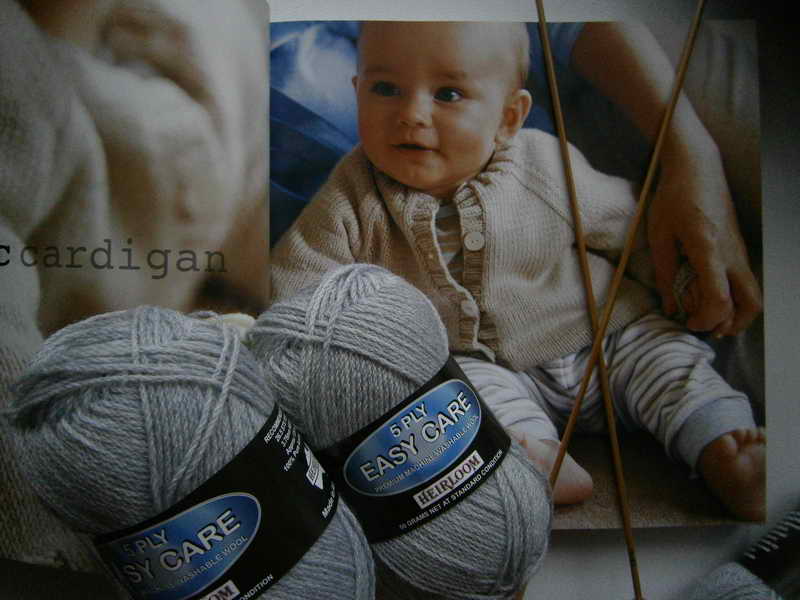
And while I was there, I picked up several balls of lovely Heirloon 5-ply in a softly-softly grey. Will be perfect for this classic raglan baby cardigan methinks. Maybe, if I am lucky, I might be able to get this on the needles this evening.
And now for the last thing, which maybe should have been the first thing, a little ta-da! Amongst the woolly jumble inherited from CC's mum back in January were a few balls of vintage Cleckheaton 8-ply. I can't decide whether it's caramel or brown rice, but I think caramel sounds better. I couldn't really date the label, but I'm guessing maybe from the 1970s? Anyway, I finished these off last night, with a crochet trim in mocha to tart them up a bit. So now that I think on it, perhaps the overall effect is cappuccino. Isn't it wonderful that yarn doesn't go off or expire? And in these days of everything-old-is-new-again I am pleased with my waste not want not baby booties. With a little more cloudy rainy weather on the cards for the weekend I am happily anticipating lots more of the clickety-clack (with pots of tea).

Happy stitching,

Evie xxx